Insights
Australia's productivity problem in numbers
We are working more hours and producing barely more per hour. Here is what the official data says, and why it lands in your pay packet.
Barely 1%.
That is how far Australia's productivity sits above its 2015 to 2019 average, according to the Productivity Commission's September 2026 update [1]. Seven years of effort. Almost nothing to show.
The latest reading is flat
In the June 2026 quarter, GDP per hour worked was unchanged. Over the year to June it fell 0.2%. Hours worked rose 2.4% while the economy grew 2.1% [2].
The Commission's own line on the March quarter says it plainly: "In aggregate, we are working harder and longer, but we are not working smarter" [3].
One caution before we get dramatic. The annual national accounts show GDP per hour worked up 0.5% across the 2025-26 financial year [4]. Different yardstick, different answer. The honest summary is not collapse. It is stuck.
It is not just a pandemic hangover
The pandemic spike and slump did distort things. Labour productivity fell by over 6% between March 2022 and June 2023, then flatlined [5]. But the Commission says output per hour "has hardly improved at all in over 10 years", and that it was slowing before that [5].
Treasury's decade averages show the longer arc [6]:
- 1960s: 2.4% a year
- 1970s: 2.4%
- 1980s: 1.2%
- 1990s: 2.3%
- 2000s: 1.4%
- 2010s: 1.1%
The 2010s were the weakest of the six decades Treasury charts. Treasury calls it the lowest rate in 60 years [6].
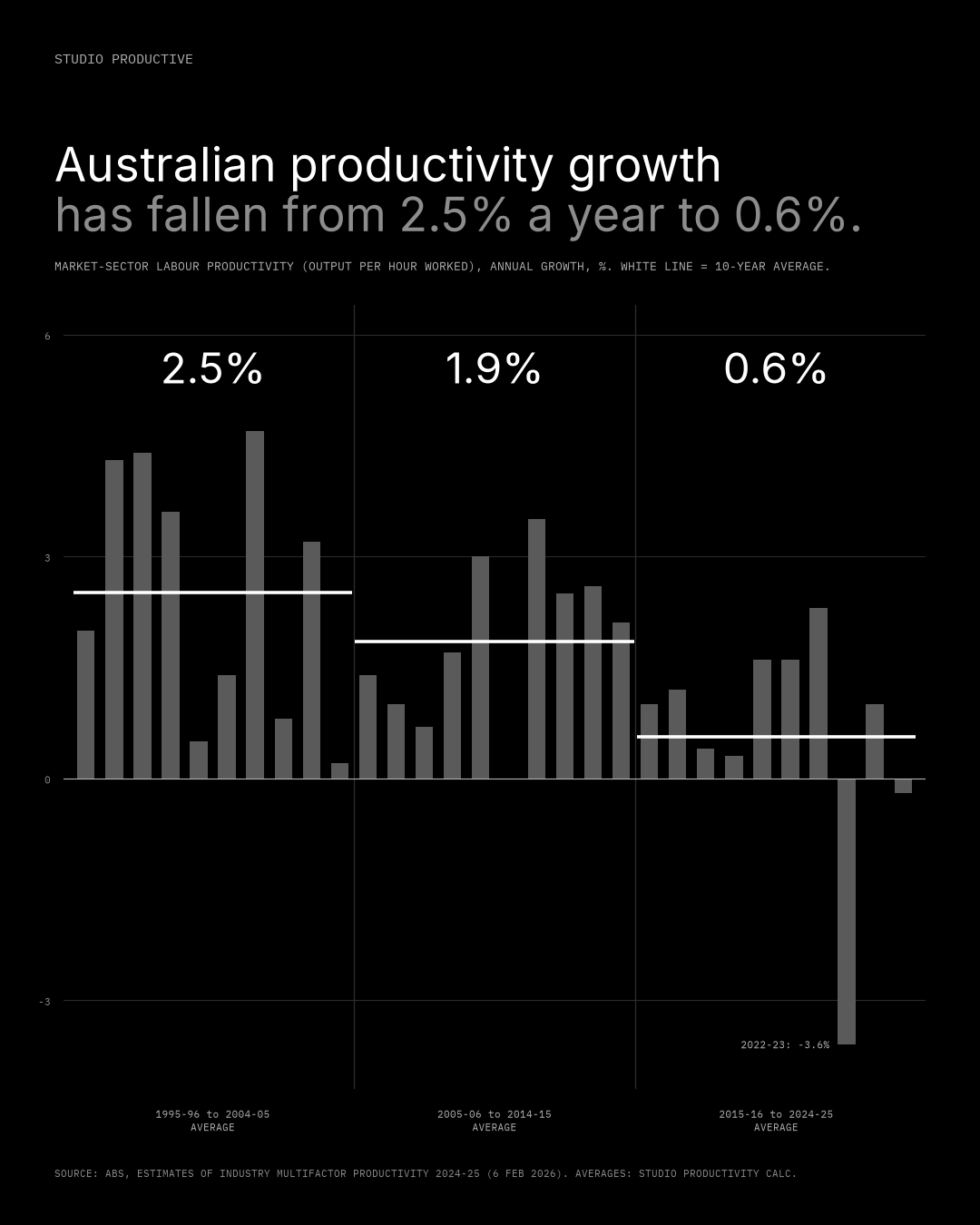
The ABS market-sector series tells the same story. Averaging its annual labour productivity growth (my calculation), the decade to 2004-05 ran at 2.5% a year. The next decade, 1.9%. The decade to 2024-25, 0.6% [7].
Why it matters at the kitchen table
Productivity is how an economy lifts real wages without lifting prices. The Commission calls it "the clearest path to sustainably improving Australians' real wages and broader living standards" [1].
Small gaps compound. Treasury modelled that a trend lift of 0.3 percentage points a year, from a 1.2% baseline, would leave real GDP about 9.5% higher and wages about 8.5% higher by 2062-63 [8]. Run it the other way: a slide from 1.2% to 0.9% a year would cut per capita real income by more than $10,000 per person over 40 years [9].
The RBA has already priced in the drag. In August 2025 it cut its medium-term productivity assumption from 1.0% to 0.7% a year, and it has held it there [10][11]. At its November 2026 media conference it said potential growth is "probably around about 2 per cent", and warned the "new normal" is that demand cannot grow quickly either [12].
So where does AI fit?
The hopeful number comes from the Commission. It judged that AI is likely to lift multifactor productivity by more than 2.3% over a decade, implying about 4.3% higher labour productivity and roughly $116 billion of extra GDP. It called that a back of the envelope estimate with "considerable uncertainty" [13].
The sober number comes from the RBA. In November, an RBA Assistant Governor said there is "limited evidence that AI has materially lifted aggregate productivity" so far, and that published estimates range from over 2% a year to just 0.1% [11][14]. Her explanation is the productivity J-curve: firms spend time and money reorganising before the gains show up [14].
Both can be true. AI is an option on the future, not yet a line in the data.
What to take from it
Three things.
- Australia's problem is long, not sudden.
- The fix is a thousand boring decisions, not one big one. The Commission says no single reform can restore productivity growth to its long-term average [1].
- The gains have to show up in the places most of us actually work: small, service-heavy businesses. Almost 90% of Australians work in service industries [15]. That is where the next article starts.
Sources
- 1Productivity Commission, Productivity update, September 2026, 3 Sep 2026
www.pc.gov.au/ongoing/productivity-insights/update-september-2026 - 2ABS, Australian National Accounts: National Income, Expenditure and Product, June 2026, 2 Sep 2026
www.abs.gov.au/statistics/economy/national-accounts/australian-national-accounts-national-income-expenditure-and-product/latest-release - 3Productivity Commission, Quarterly productivity bulletin, June 2026, June 2026
www.pc.gov.au/ongoing/productivity-insights/bulletins/quarterly-bulletin-june-2026 - 4ABS, Australian System of National Accounts, 2025-26, 23 Oct 2026
www.abs.gov.au/statistics/economy/national-accounts/australian-system-national-accounts/latest-release - 5Productivity Commission, Labour productivity: There and back again, 27 Mar 2025
www.pc.gov.au/media-speeches/articles/labour-productivity - 6Treasury, Economic Reform Roundtable: Productivity overview, Aug 2025
treasury.gov.au/sites/default/files/2025-08/productivity-overview.pdf - 7ABS, Estimates of Industry Multifactor Productivity, 2024-25, 6 Feb 2026 (averages calculated by Studio Productive)
www.abs.gov.au/statistics/industry/industry-overview/estimates-industry-multifactor-productivity/latest-release - 8Treasury, Secretary's speech on the 2023 Intergenerational Report, 9 Oct 2023
treasury.gov.au/speech/2023-intergenerational-report - 9Treasury, Economic Reform Roundtable: Productivity overview (as [6]), citing the 2023 Intergenerational Report.
- 10RBA, Statement on Monetary Policy, August 2025: Drivers and implications of lower productivity growth, Aug 2025
www.rba.gov.au/publications/smp/2025/aug/in-depth-drivers-and-implications-of-lower-productivity-growth.html - 11RBA, Sarah Hunter, Q&A transcript, UBS Australasia Conference, 9 Nov 2026
www.rba.gov.au/speeches/2026/sp-ag-2026-11-09-q-and-a-transcript.html - 12RBA, Media conference: monetary policy decision, 3 Nov 2026
www.rba.gov.au/speeches/2026/mc-gov-2026-11-03.html - 13Productivity Commission, Harnessing data and digital technology, Inquiry report no. 111, released 19 Dec 2025
www.pc.gov.au/inquiries-and-research/data-digital/report - 14RBA, Sarah Hunter, What Happens to the Economy as 'Intelligence' Gets Cheaper?, 9 Nov 2026
www.rba.gov.au/speeches/2026/sp-ag-2026-11-09.html - 15Productivity Commission, 5-year Productivity inquiry report, 17 Mar 2023
www.pc.gov.au/inquiries-and-research/productivity/report